
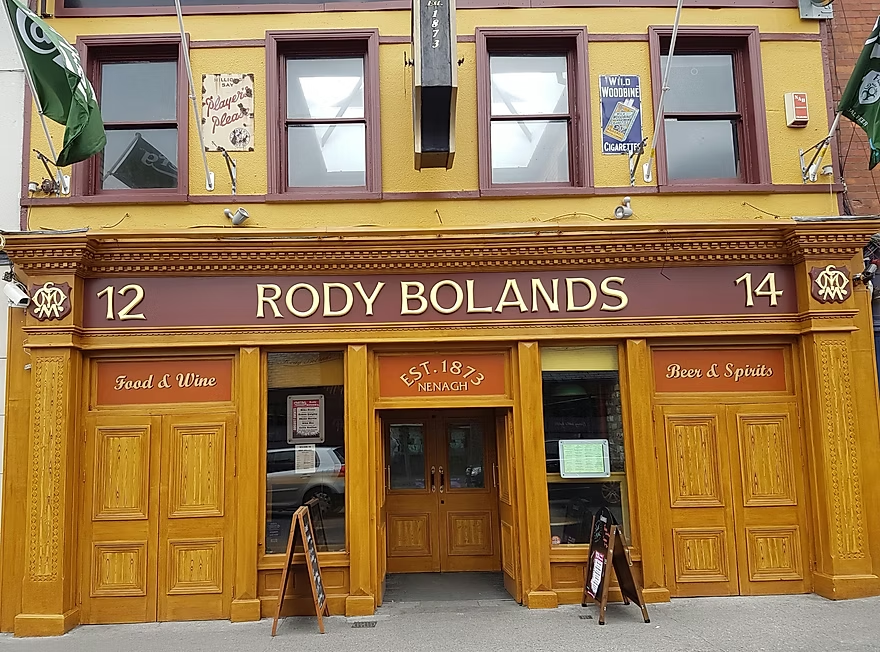
Rody Bolands
Rathmines, Dublin
About
Pictures
Discover
Rody’s has a rich and storied past, full of Irish charm. Originally founded in Nenagh in 1873 by the MacMahon family from Clare, it was later passed to the Bolands at the start of the 20th century. In 1994, the original furnishings—including the counter, back fitting, and pub front—were lovingly moved to Rathmines, where you can still see them today, along with old ledgers and cosy snugs.
An Irish pub has stood on Upper Rathmines Road for over 200 years, and today Rody’s is proudly family-run by Nenagh man Kieran O’Meara and his son Brian.
You’ll always find a warm welcome here, with old-world surroundings and a modern twist. Rody’s has become a go-to dining destination, offering seasonal Irish menus made with fresh, locally sourced ingredients, along with artisanal cocktails, craft beers, fine wines, and an impressive collection of spirits from around the globe.
Upstairs, you’ll find Mick Mac’s Bar—named after former owner Michael McMahon—a cosy function room perfect for birthday parties, family get-togethers, local events, and corporate gatherings.
Address
12 Rathmines Road Upper, Dublin 6
Opening
Tue – Thur: 4pm – 12am
Fri: 4pm – 1am
Sat: 1pm – 1am


Interviews, stories, videos and curious facts about this pub.
Videos
Audios
Interviews
Curiosities
1. If these walls could talk, what would be the most unbelievable story they’d tell?
The walls would tell you about the great 19th-century church-hour hustle. Our original landlady, Nancy, would stand inside a dark, hollowed-out section of the front brickwork during mandatory Sunday afternoon closures. To bypass the strict laws, she would silently pass frothing pints out into the Dublin afternoon through a tiny hole in the wall. The walls would describe the bizarre sight of disembodied hands delivering alcohol to a crowded street of locals trying to look inconspicuous! Hence the name, Nancy hands.
2. Who is the most memorable customer who’s ever been here?
The famous staircase linked to Michael Caine and Educating Rita . Originates from Trinity College Dublin and now resides inside the pub. After restructuring and renovations, the staircase – trodden on by Michael Caine during the film’s production—was installed in the pub. So, even though the Academy award winning actor wasn’t physically in the pub, he did walk on our staircase.
3. In your opinion, what makes a pub a true Irish pub, rather than just a bar that serves Guinness?
A true Irish pub is an extension of the community’s living room, whereas a regular bar is just a commercial place to buy a drink. An authentic pub focuses entirely on human connection, cultural heritage, and unhurried hospitality. It features a layout meant for face-to-face interaction, a crackling atmosphere of craic (conversation and fun), and local music traditions that feel entirely unforced. The focus is always on welcoming the person, not just serving the pint.
4. What Irish tradition would you like the rest of the world to adopt?
The world should adopt the tradition of the “Irish Snug.” Historically, snugs were small, private, wood-panelled enclosures inside a pub with their own access doors and service hatches. They allowed people to have deeply private conversations, share secrets, or reflect in quiet comfort right in the middle of a bustling public house. Bringing back small, distraction-free spaces for deep, uninterrupted human connection would do the modern world a lot of good.
5. What sets a good pub conversation apart from a conversation anywhere else?
A great pub conversation is defined by its complete lack of social hierarchy. At the bar counter, a university student, a bricklayer, a corporate lawyer, and a visiting tourist all sit on identical wooden stools. The shared environment strips away outside pretenses. This democratic setup encourages a blend of quick-witted humor, storytelling, and an openness to talking with complete strangers that you rarely find in standard coffee shops or restaurants.
6. In your opinion, what makes a pub feel “timeless,” even after so many years?
Timelessness comes from a pub’s tactile authenticity and layers of history. You can feel it in the uneven, worn wooden floorboards, the antique Victorian decor, and original factory clocking machines that local ancestors used generations ago. When a building retains its physical connection to the past and refuses to chase modern, minimalist design trends, it provides a sense of permanent comfort. It makes you feel like you are stepping into a living museum where the clock has stopped.